Chapter 01 · Foundational Math
Your notes
Bookmarks
Calculator
01.01
Addition, Subtraction, Multiplication, and Division
Four operations and their properties, negative numbers, the order of operations, long division with remainders, and arithmetic with fractions.
About 35 minutes
You'll learn to
- →Use inverse operations and the commutative, associative and distributive properties to compute and check
- →Add, subtract, multiply and divide negative numbers
- →Evaluate expressions using the order of operations
- →Do long division and interpret the remainder
- →Add, subtract, multiply and divide fractions
1. Four operations and their properties
Everything in arithmetic is built from four operations. Their answers have names: a sum (), a difference (), a product () and a quotient (). This concept is about the rules they follow: rules that let you compute faster, and check your work.
Inverse operations
Two operations are inverse operations when doing one and then the other, with the same number, always gives back the number you started with. For any numbers and :
So subtraction undoes addition, and division undoes multiplication.
That's why asks "what do I add to to get ?" (the answer is ), and asks "what do I multiply by to get ?"
That makes every subtraction and division easy to check. Is ? Multiply back: , so yes.
It also explains why you can't divide by . would be a number that gives when multiplied by . But every number times is , so there is no such number: is undefined.
Reordering and regrouping
For addition and multiplication, order and grouping don't matter. For any numbers , and (the letters are placeholders: each rule holds whatever numbers you put in):
Commutative property: and .
Associative property: and .
Together they say you may add a list of numbers, or multiply a list of numbers, in any order. Use that to pair numbers that combine nicely:
Subtraction and division have neither property.
- Order matters: , but .
- Grouping matters: , but .
The distributive property
A number written right next to parentheses means multiplication: means . Letters side by side mean the same, so is , and is . From here on, products are often written this way instead of with .
Distributive property: for any numbers , and ,
Multiplying a sum means multiplying each part of it.
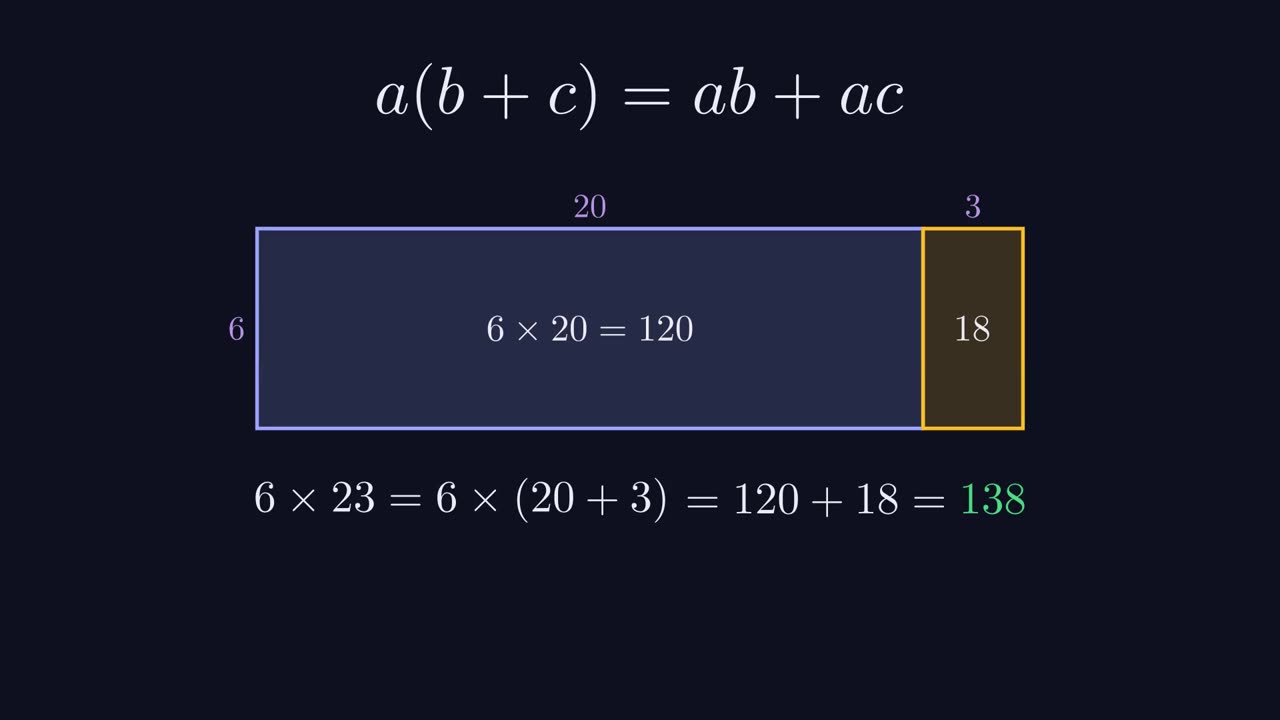
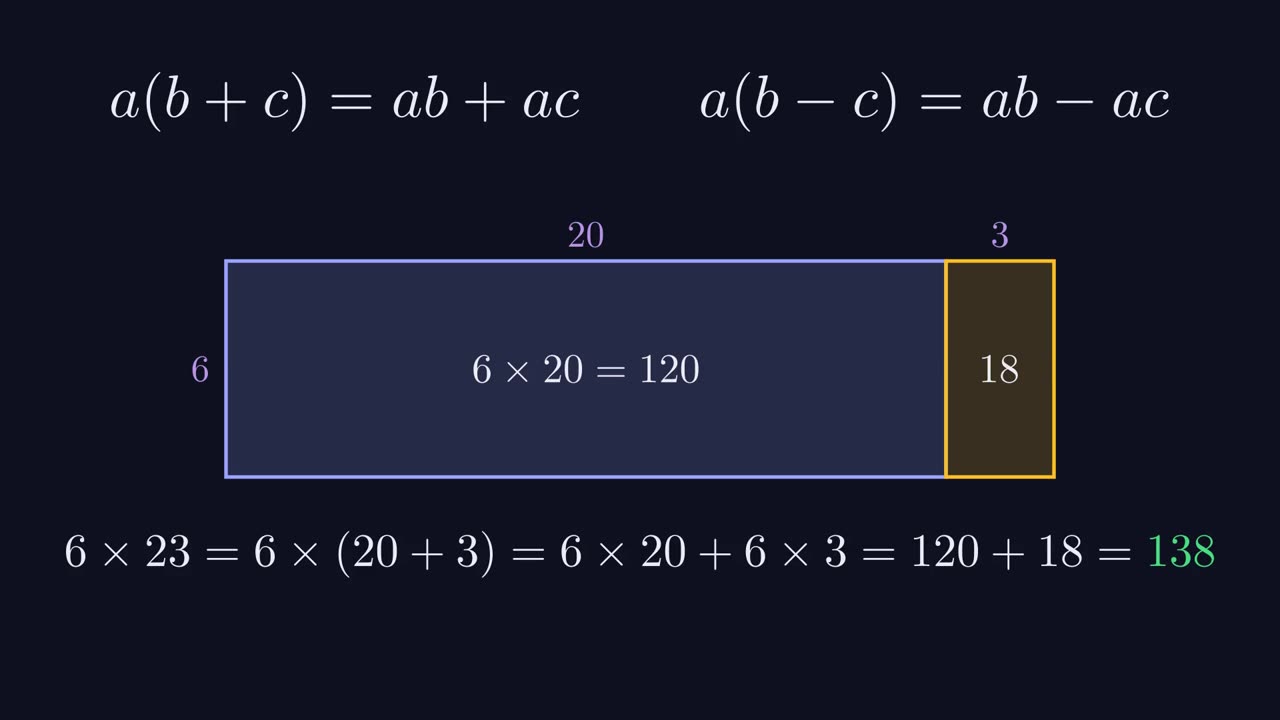
A rectangle shows why. A by rectangle can be cut into a by piece and a by piece, and the two areas add up to the whole:
Compute . Since ,
Check by the long way if you like: .
The law also works backwards: .
- Distributing to only one part. is not : the multiplies the as well.
- Reordering a subtraction or a division. is , worked left to right; it is not .
Each operation has an inverse that undoes it: subtraction undoes addition, and division undoes multiplication. So because .
Addition and multiplication can be reordered (commutative) and regrouped (associative). Multiplication distributes over addition and subtraction:
Here , and stand for any numbers.
.
2. Negative numbers
Negative numbers measure things below a starting point: temperatures below zero, depths below sea level, money owed. On the number line they sit to the left of .
The opposite of a number is its mirror image across : the opposite of is , and the opposite of is . A number and its opposite add to .
The absolute value is a number's distance from , so it is never negative: and .
In words: if is positive or , then . If is negative, then , its opposite, which is positive. For example, .
Adding and subtracting
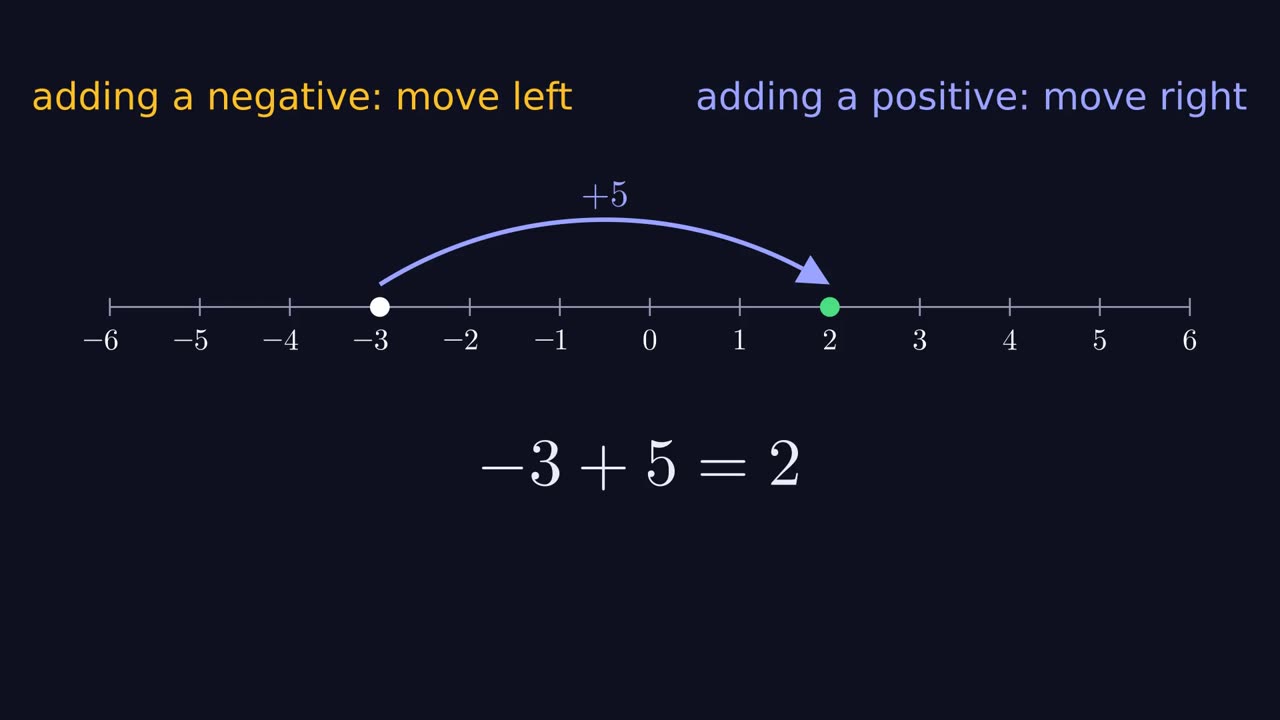
Think of adding as moving along the number line: adding a positive number moves right, adding a negative number moves left.
Starting at and moving to the right lands on , so .
Subtraction undoes addition, so subtracting moves to the left: the same as adding .
Subtracting is adding the opposite
In general, subtracting a number is adding its opposite:
That turns every subtraction into an addition, and additions follow two rules. With the same sign, add the sizes and keep the sign: . With different signs, subtract the sizes and take the sign of the larger one: , and .
.
Multiplying and dividing
A positive number times a negative number is repeated addition of the negative number: . What about a negative times a negative? Follow the pattern as the first factor goes down by :
Each answer is more than the one before, so the next is . The distributive law proves it: since ,
so must be the number that adds to to give : it is . The rules are:
- Same signs: the product (or quotient) is positive. .
- Different signs: it is negative. .
Division follows the same rules, because it undoes multiplication: since .
. With several factors, count the negatives: an even number of them gives a positive result, an odd number a negative one. Here there are three, so the answer is negative.
- "Two negatives make a positive" in an addition. That rule is for multiplying and dividing. is : two debts add up to a bigger debt.
- Losing the sign of a subtraction. is , not : start at and move further left.
On the number line, adding a positive number moves right and adding a negative moves left. Subtracting is adding the opposite: .
When you multiply or divide two numbers, same signs give a positive result and different signs give a negative one: , .
.
3. Order of operations
What is ? Adding first gives ; multiplying first gives . Both can't be right, so mathematicians agree on one order. It isn't a fact to be proved, it's a convention, like driving on one side of the road, and everyone who writes math uses it.
The order
- Grouping symbols: parentheses , brackets and fraction bars. Work inside them first, innermost first.
- Exponents. means (section 01.02 has more).
- Multiplication and division, on the same level: work them from left to right.
- Addition and subtraction, also on the same level, from left to right.
You may know this as PEMDAS. The letters can mislead: M comes before D in the word, but multiplication does not come before division. Whichever comes first, reading left to right, goes first. The same is true of addition and subtraction.
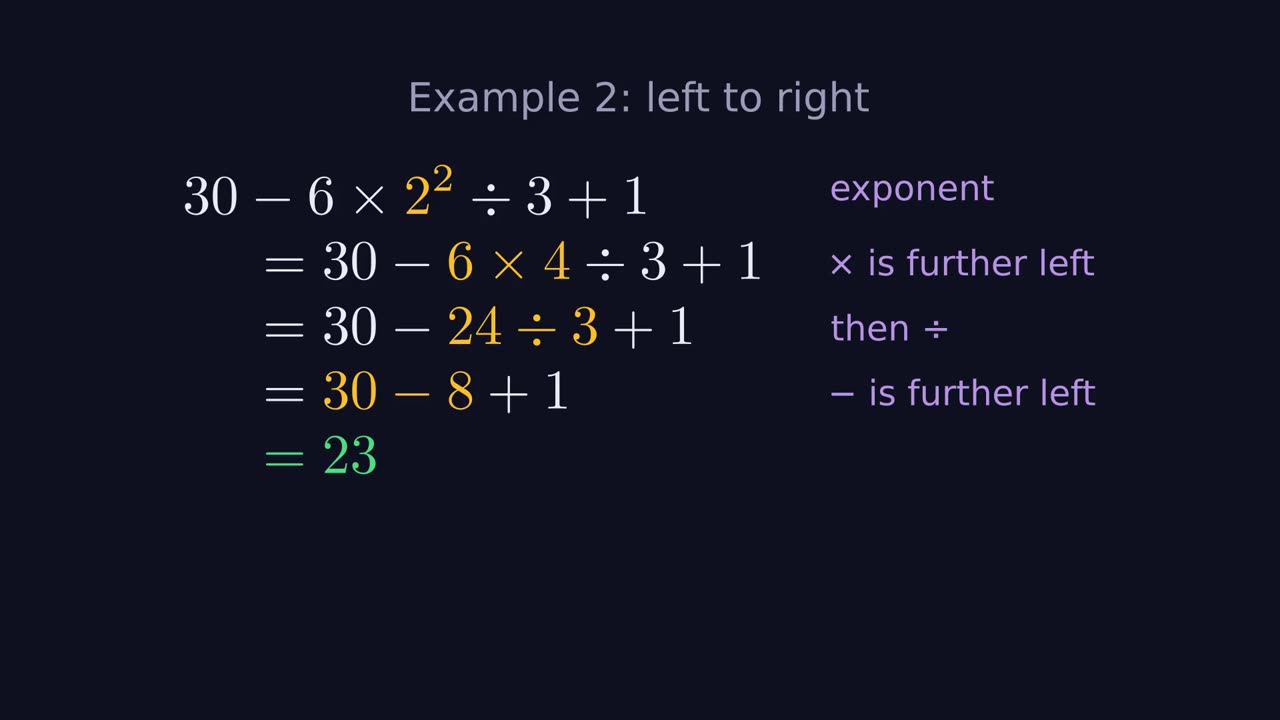
Parentheses, then the exponent, then the multiplication, then the addition.
After the exponent, comes before because it is further left. At the end, comes before for the same reason.
Write it so nobody has to guess. The rules settle every expression, but long chains are easy to misread. When you write math yourself, add parentheses to show the grouping you mean, even where the rules don't need them: looks busier, but nobody has to stop and work out which step comes first.
A fraction bar works like parentheses around its top and around its bottom:
Exponents and negative signs
The exponent applies only to what it touches. , but means : the exponent goes first, then the negation.
- Multiplying before dividing because M comes first in PEMDAS. is , not .
- Adding before subtracting. is , not .
- Working left to right through everything. In the multiplication still comes first: .
When an expression has more than one operation, do them in this order:
- Grouping: parentheses, brackets, fraction bars, innermost first
- Exponents
- Multiplication and division, together, from left to right
- Addition and subtraction, together, from left to right
.
4. Long division and remainders
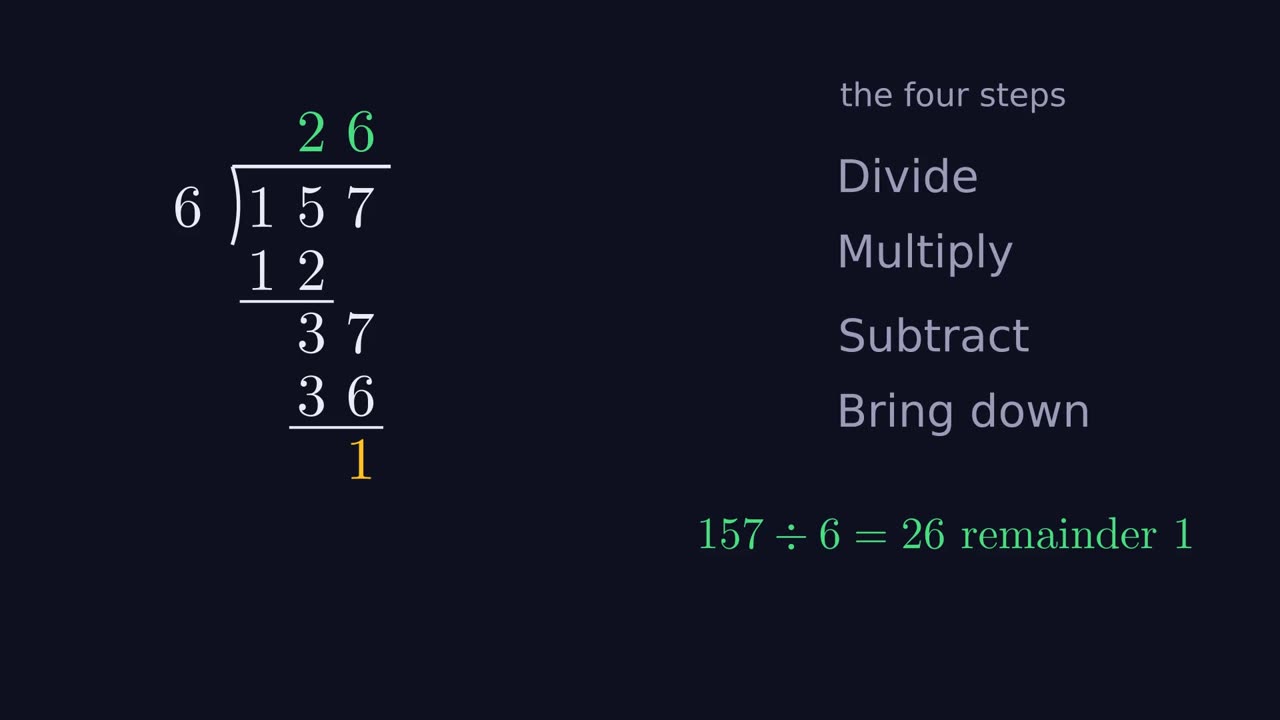
When a whole number is divided by a whole number , is the dividend and the divisor. The quotient is the number of whole times fits into , and the remainder is what's left over, so that
In , the dividend is and the divisor is : fits whole times (the quotient), with left over (the remainder).
The method
Long division handles a big division one digit at a time, repeating four steps:
- Divide: how many times does the divisor go into the number you're looking at?
- Multiply that digit by the divisor.
- Subtract to find what's left.
- Bring down the next digit, and repeat.
goes into twice (), leaving . Bring down the to make . goes into six times (), leaving . So remainder .
Checking a division
The remainder must be smaller than the divisor: if it weren't, the divisor would fit at least once more. Every division checks with one multiplication:
: goes into twice, leaving . Bring down the : goes into zero times, so write in the quotient and bring down the to make . goes into five times (), leaving . So remainder . Check: .
What the remainder means
The remainder is the part that didn't divide evenly. What to do with it depends on the question.
- As a fraction of the divisor: , a mixed number: wholes and sixth. (section 01.04 turns it into a decimal.)
- Round up when everything must fit: students in buses that seat is remainder , so buses, or students are left behind.
- Drop it when only full groups count: eggs fill cartons of a dozen, with egg left over.
- Skipping a zero in the quotient. In the second example, leaving out the gives remainder , which is far too small: .
- A remainder as big as the divisor. " remainder " adds up correctly, but still fits into once more.
Long division repeats four steps: divide, multiply, subtract, bring down. What's left at the end is the remainder, always smaller than the divisor. Check with
remainder , since . As a mixed number, .
5. Arithmetic with fractions
A fraction is divided by : cut a whole into equal parts and take of them. The top number is the numerator, the bottom the denominator (never , since we can't divide by ).
Equivalent fractions and simplifying
Multiplying the top and bottom by the same nonzero number cuts each part into smaller pieces without changing the amount: . These are equivalent fractions.
Going the other way simplifies a fraction: divide the top and bottom by a common factor. . A fraction is in lowest terms when the top and bottom have no common factor but .
Adding and subtracting
You can only add pieces of the same size. Rewrite both fractions with a common denominator, preferably the smallest one (the least common denominator), then add the numerators:
The denominator stays : eight twelfths and nine twelfths make seventeen twelfths.
: the least common denominator of and is , so .
Multiplying
Half of a third is a sixth, : "of" means multiply. No common denominator is needed. Cancel common factors before multiplying to keep the numbers small:
Dividing
The reciprocal of is : the fraction flipped, so that the two multiply to .
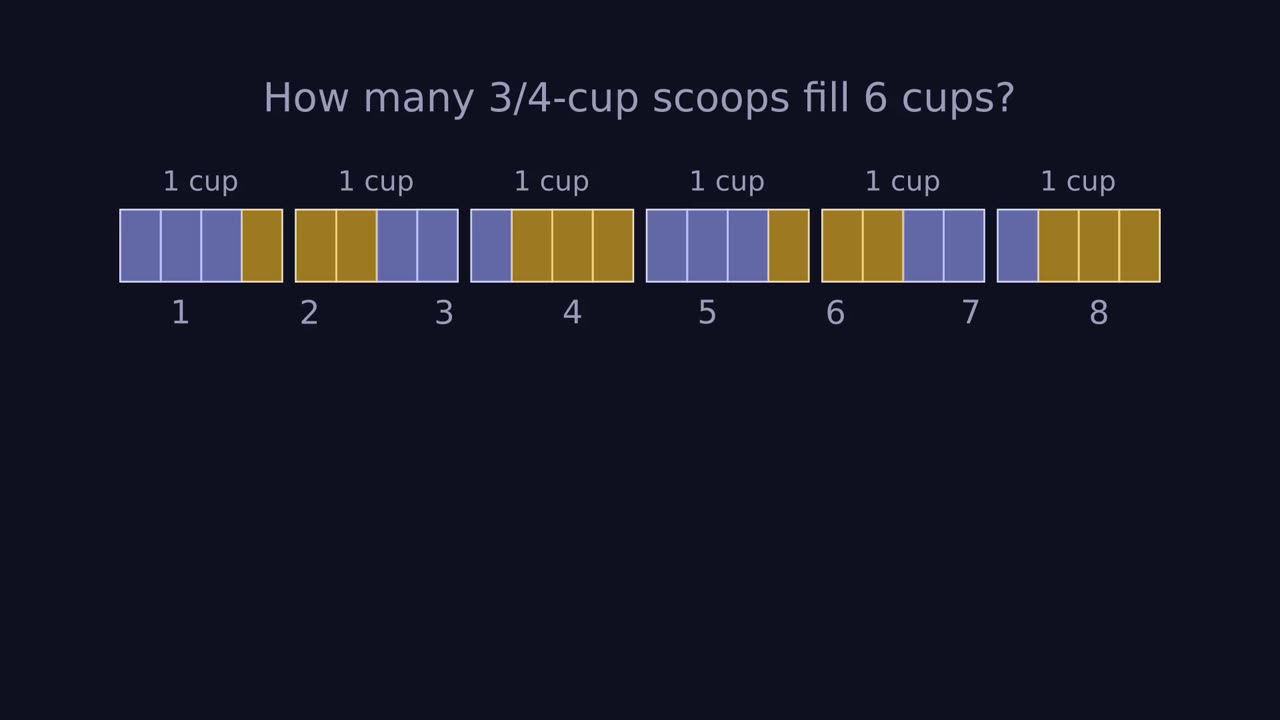
Why? Division undoes multiplication. How many -cup scoops fill cups? Each cup holds scoops, so , and indeed .
.
Mixed numbers
Turn a mixed number into an improper fraction (top bigger than the bottom) before multiplying or dividing: , because wholes are . Then .
- Adding tops and bottoms. is not ; that's less than alone. Use a common denominator.
- Multiplying mixed numbers part by part. is not : convert to improper fractions first.
- Flipping the wrong fraction when dividing. Only the second one (the divisor) is flipped.
- Simplify by dividing the top and bottom by a common factor: .
- Add or subtract over a common denominator: .
- Multiply straight across: .
- Divide by multiplying by the reciprocal: .
Ready for more? The Practice tab has 11 more problems on the whole lesson.
Definitions
- Inverse operations
Two operations that undo each other: doing one and then the other with the same number gives back what you started with, and for . So because .
- Commutative property
Addition and multiplication can be done in either order: and . Subtraction and division can't.
- Associative property
Addition and multiplication can be regrouped: and .
- Distributive property
Multiplying a sum multiplies each part of it: , and .
- Opposite
The number the same distance from on the other side: the opposite of is . A number plus its opposite is .
- Absolute value
A number's distance from , never negative: .
- Order of operations
The agreed order for evaluating: grouping, then exponents, then multiplication and division from left to right, then addition and subtraction from left to right.
- Dividend, divisor, quotient, remainder
In remainder : is the dividend, the divisor, the quotient and the remainder, which is always smaller than the divisor.
- Equivalent fractions
Fractions with the same value, made by multiplying or dividing the top and bottom by the same nonzero number: . A fraction is in lowest terms when the top and bottom have no common factor but .
- Least common denominator
The smallest number that every denominator divides into: for and it is .
- Reciprocal
The reciprocal of is ; the two multiply to . Dividing by a fraction is multiplying by its reciprocal.
- Mixed number
A whole number and a fraction less than together: .
Formulas
Commutative properties
Associative properties
Distributive property
Subtracting is adding the opposite
Signs of products and quotients
the same for division: same signs give a positive result, different signs a negative one
Order of operations
and together from left to right, then and together from left to right
Checking a division
with
Equivalent fractions
Adding fractions
any common denominator works; the least one keeps the numbers small
Multiplying fractions
Dividing fractions
multiply by the reciprocal of the divisor;
Study
Apply it
Real-world problems that take several steps. Work through them one step at a time, with each step checked as you go.
Practice
11 practice problems with instant feedback, hints and worked solutions.
Sign up free to practice