Chapter 06 · Derivatives
Your notes
Bookmarks
Calculator
06.01
Definition of the Derivative
From the slope of a secant line to the slope of the tangent line: the derivative as a limit, as a function, and as a graph.
About 45 minutes
You'll learn to
- →Compute an average rate of change and simplify a difference quotient
- →Compute the derivative at a point from the limit definition
- →Find the derivative function from the limit definition
- →Sketch the graph of f' from the graph of f, and read the shape of f from f'
- →Find the equation of a tangent line
- →Interpret a derivative as a rate of change with units, and recognize a limit as a derivative
1. Average rate of change and secant lines
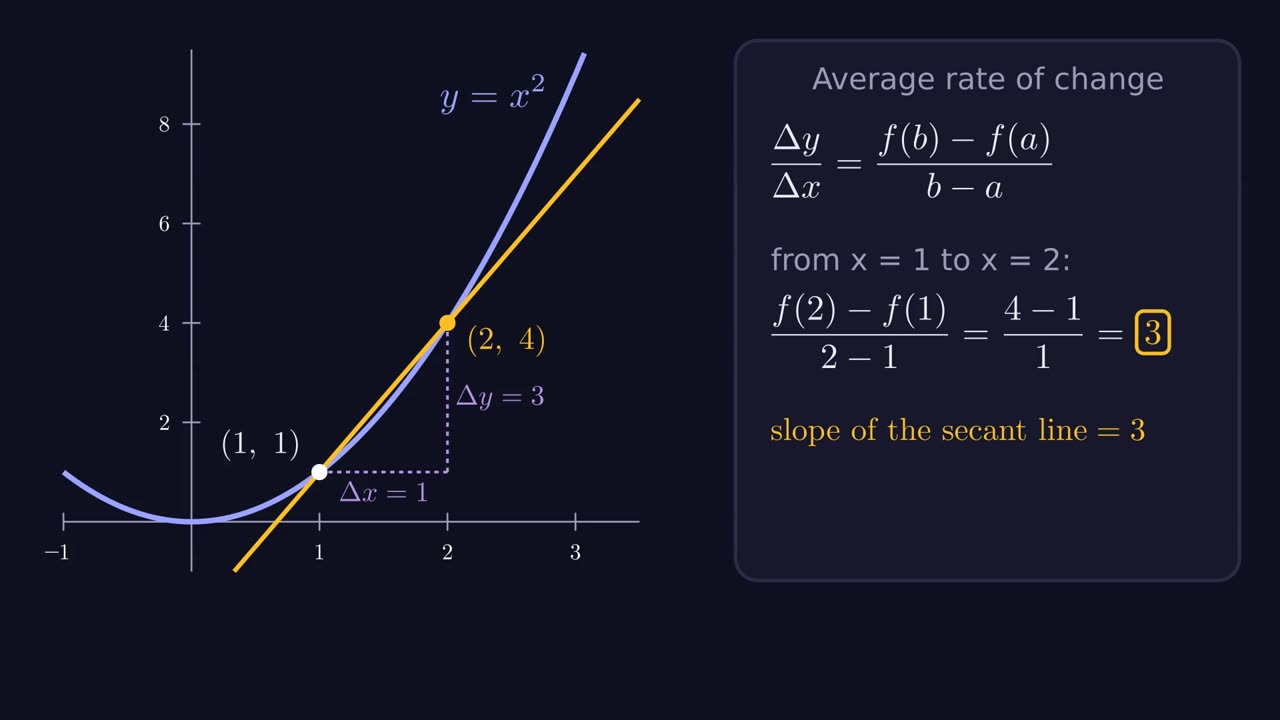
Calculus begins with a question about change: how fast is a quantity changing right now? Before we can answer it, we need the simpler idea of change over an interval.
The average rate of change of on the interval from to is the change in output divided by the change in input.
Geometrically, this is the slope of the secant line: the line through the two points and on the graph. Physically, if is the position of a car at time , it is the car's average velocity over that stretch of time: total distance covered divided by time taken.
The difference quotient
It is often convenient to describe the second point by how far it is from the first. Write , where is the step size. Then , and the average rate of change becomes the difference quotient:
The step can be positive (the second point is to the right) or negative (to the left). Everything in this lesson grows out of this one expression.
For on , the average rate of change is
Using the difference quotient with :
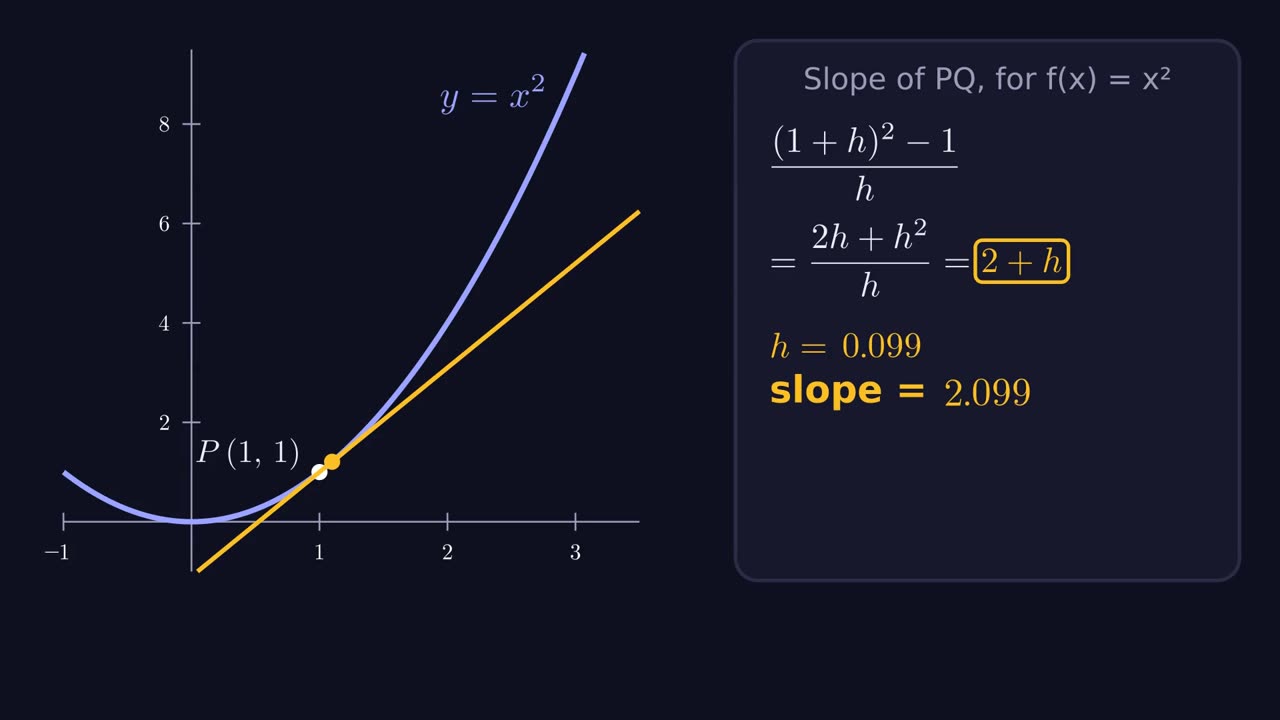
With this gives , as before. With it gives ; with , ; with , .
As the second point slides toward , the secant lines tilt and their slopes close in on a single number, . The line they settle onto touches the parabola at : it is the tangent line. Making "close in on" precise is exactly what limits are for.
means "evaluate at the input ." It is not . For , , not .
The average rate of change of from to is the slope of the secant line through and :
Writing gives the difference quotient , the form the derivative is built from.
For from to , the average rate of change is , the slope of the secant line below.
2. The derivative at a point
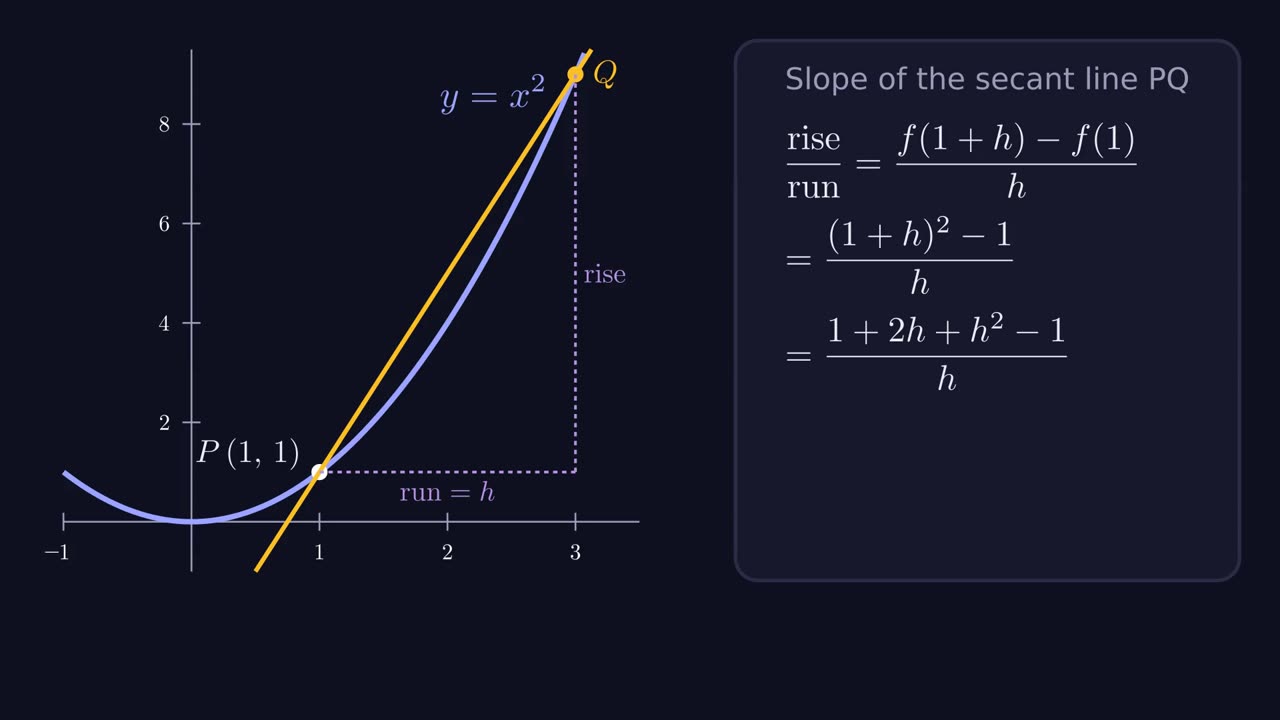
The difference quotient measures change over an interval of width . To measure change at a single instant, we let the interval shrink.
The derivative of at is the limit below, provided it exists. When it does, is differentiable at .
We can't simply substitute : that gives , which is meaningless. As in section 05.03, the plan is to simplify the quotient algebraically until the troublesome factor of cancels, and then let .
Find for .
The cancellation is valid because inside the limit.
Find for . First, and
So
An equivalent form
Setting , so that and exactly when , gives a second, equivalent formula:
Use whichever makes the algebra easier. For at , the second form factors neatly: .
Every derivative from the definition follows the same four steps:
- Write out carefully.
- Subtract and simplify the numerator.
- Divide by ; a factor of should cancel.
- Let .
Let the step shrink to zero. The limit of the difference quotient is the derivative of at , the slope of the tangent line there:
For at : , so .
3. The derivative as a function
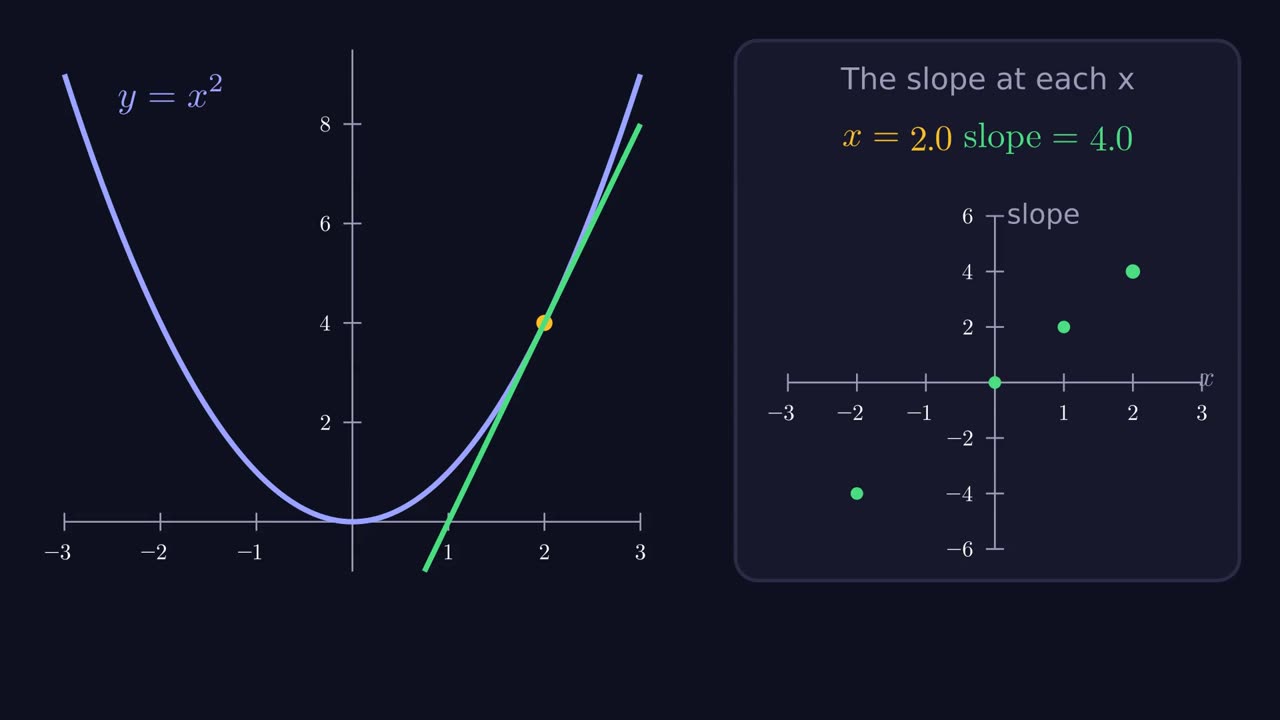
Computing , then , then , each from scratch, repeats the same algebra. It is more efficient to leave the point general.
The derivative of is the function given by the limit below, at every where the limit exists. Its domain is the set of points where is differentiable, which can be smaller than the domain of (section 06.02 looks at where this fails).
So and , agreeing with the examples above, and now every slope is available at once. Notice that is held fixed while varies: inside the limit, behaves like a constant.
The numerator is a difference of fractions, so combine them over a common denominator:
Dividing by cancels the :
The slope is negative everywhere, which matches the graph of : on each side of it falls from left to right.
Square roots call for the conjugate. Multiply the top and bottom by :
Letting :
Here is defined at but is not: the graph of starts with a vertical tangent at the origin.
- Cancelling before simplifying the numerator. In you can't "cancel the " in ; expand first.
- Letting too early. If you still have , there is more algebra to do.
- Forgetting the domain: the formula for may need restrictions such as or .
Do the same limit at a general point and you get a new function, , that gives the slope at every :
For : , so .
4. Graphs of f and f′
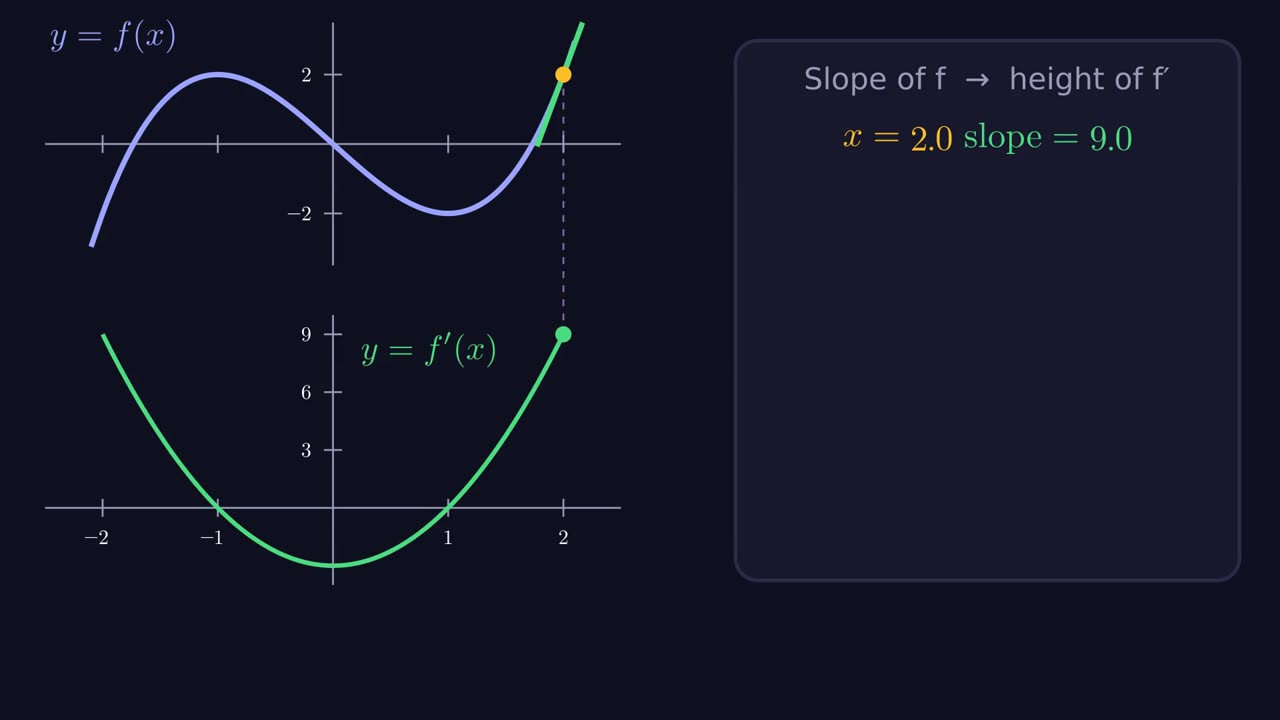
In the last concept became a function in its own right, and a function has a graph. The graph of is tied to the graph of point by point: the height of at is the slope of at . That lets you sketch from a picture of without any algebra, and read the shape of from a picture of .
Reading slopes off a graph
Picture a tangent line sliding along the graph of from left to right. At each , note its slope and plot that number as the height of the graph of . Four observations do most of the work.
- Horizontal tangents. At a peak, a valley or any flat spot, the tangent line is horizontal, so : the graph of meets the -axis there.
- Rising and falling. Where is increasing (rising from left to right), its tangent lines have positive slope, so and the graph of is above the -axis. Where is decreasing, and the graph of is below the axis.
- Steepness. The steeper the graph of , the larger , so the farther the graph of is from the -axis. Where is nearly flat, is close to .
- Corners and vertical tangents. Where the graph of has a sharp corner, or a vertical tangent line, there is no single finite slope, so is undefined there. Section 06.02 studies these points.
Notice what is missing from the list: the height of . Whether is large, small, positive or negative has nothing to do with the value of .
Sketch the graph of for , graphed below.
Read the graph of from left to right.
- To the left of , rises, steeply at first and then more gently. So is positive, large at first, and shrinking toward .
- At , has a peak. The tangent is horizontal, so .
- Between and , falls, so is negative. The fall is steepest in the middle, near , so that is where is lowest.
- At , has a valley, so .
- To the right of , rises more and more steeply, so is positive and growing.
So the graph of is a U-shaped curve: positive, down through at , negative in between with its lowest point near , back up through at , and positive after. The definition confirms the sketch. Expanding,
so , which is at and at .
Open in grapher (opens in a new tab)
Open in grapher (opens in a new tab)
The dashed lines mark matching -values. The peak and the valley of line up with the zeros of , not with its high or low points.
Suppose all we know is that , a line through . What does the graph of look like?
- For , , so is decreasing. For , , so is increasing.
- At , is and changes from negative to positive: stops falling and starts rising, so it has a valley (a low point) at .
- grows as moves away from in either direction, so gets steeper on both sides.
So is U-shaped with its lowest point at . But where is that lowest point? The derivative doesn't say. The function has derivative (check it from the definition: the quotient simplifies to ), and so do , , and for every constant . Adding a constant slides the graph up or down without changing a single slope.
determines the shape of , but not its height.
To pin down you also need one point on its graph, such as the value . (Antiderivatives, in chapter 08, start from exactly this idea.)
Sketch for .
For the graph is the line , with slope , so . For it is the line , so . At the graph has a corner: the slope jumps from to and there is no single tangent line, so is undefined. The graph of is two horizontal pieces with a gap at .
Open in grapher (opens in a new tab)
A vertical tangent causes the same problem in a different way. The graph of is smooth at the origin, but its tangent line there is vertical: near the slopes grow without bound, so the graph of shoots upward on both sides and is undefined. Section 06.02 sorts out these cases.
- Drawing as a copy of . The graph of records slopes, not heights. In Example 1, has a peak at , and is there.
- Treating a high point of as a high point of . At the top of a hill the tangent is flat, so is zero. The high points of are where climbs most steeply.
- Reading the sign of from the height of . means is falling at , not that is below the -axis. In Example 1, is positive, but is negative.
- Expecting to fix completely. Many functions share one derivative; they differ by a vertical shift.
The graph of plots the slope of at each :
- at horizontal tangents: peaks, valleys and flat spots;
- where is increasing, and where it is decreasing;
- the steeper is, the larger ;
- at a corner or a vertical tangent, is undefined.
Going backwards, gives the shape of but not its height: and have the same derivative.
has a peak at and a valley at , so is at exactly those two points, negative between them (where falls) and positive outside them (where rises).
5. The tangent line
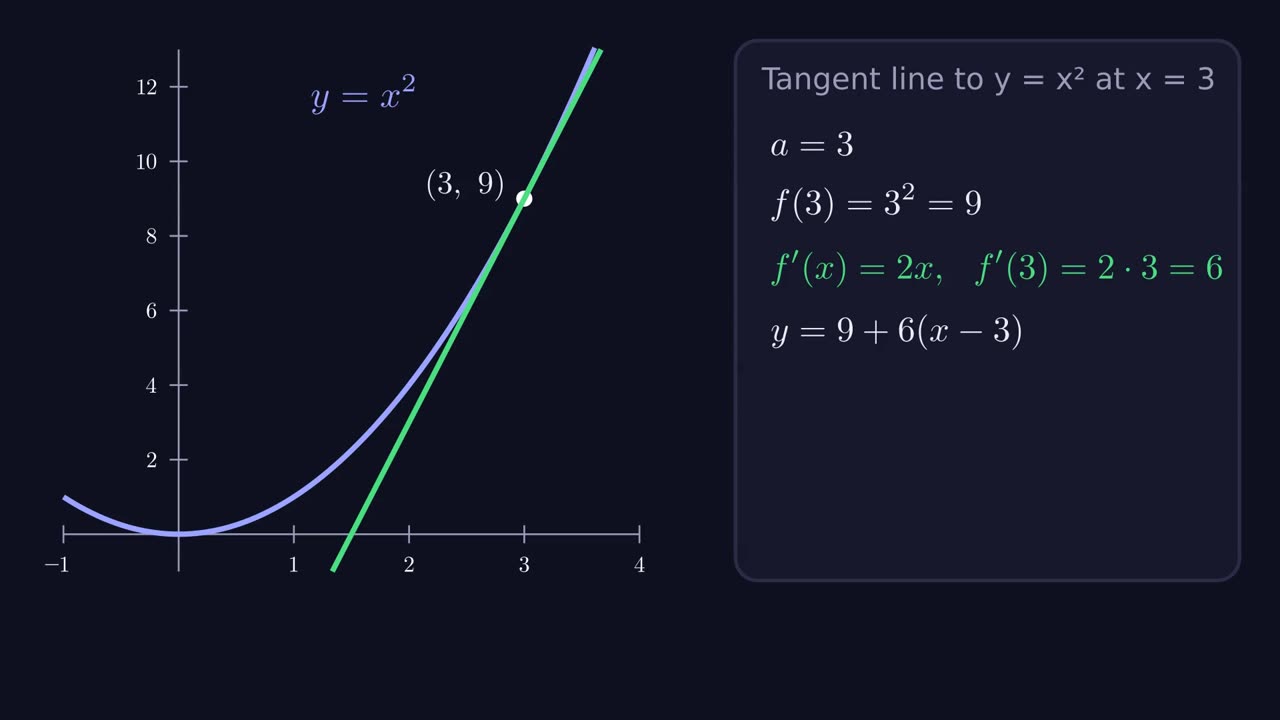
We have been calling "the slope of the tangent line." Now we can make that the definition.
If is differentiable at , the tangent line to at is the line through that point with slope . In point-slope form:
So finding a tangent line takes three numbers: the point's -coordinate , its -coordinate , and the slope .
Find the tangent line to at . The point is and the slope is , so
Find the tangent line to at . The point is and, from the derivative of above, . So
Why it matters: the best straight-line approximation
Zoom in far enough on a differentiable function and its graph looks straight; the line it looks like is the tangent line. Near :
For example, the tangent line to at is , which estimates . The true value is . This idea, linear approximation, returns in section 07.04.
The slope of the tangent line is the number , not the function . "The tangent line to at is " is wrong: that isn't even a line. Evaluate at first.
The tangent line to at passes through with slope :
For at : .
6. Reading and recognizing derivatives
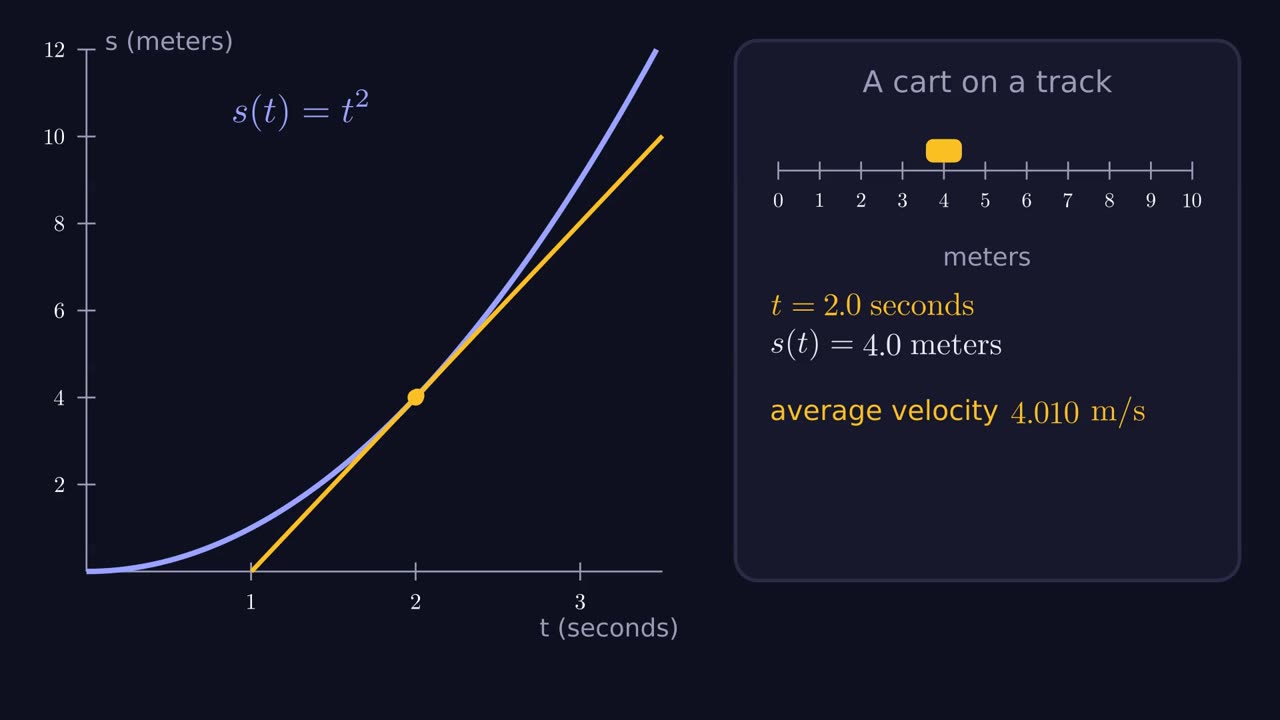
Rates of change
The derivative is the instantaneous rate of change: the limit of average rates over shorter and shorter intervals. Its meaning depends on what measures.
- If is position at time , then is the velocity at time .
- If is the cost of producing items, is the marginal cost: approximately the cost of producing one more item.
- If is the temperature at altitude , says how fast temperature changes as you climb.
Units. Because is a limit of , its units are "units of output per unit of input." If is in meters and in seconds, is in meters per second. If is in dollars and in items, is in dollars per item. So means: at a production level of 500 items, cost is rising at about $80 per additional item.
Notation
Several notations are in common use, all meaning the same thing:
Lagrange's prime notation is compact. Leibniz's recalls where the derivative comes from, , and makes the units visible. The derivative at a point can be written or . The symbol is an operator: an instruction to take the derivative of whatever follows, as in .
Recognizing a derivative in disguise
Every limit of the form is a derivative, even when it isn't labeled as one.
To evaluate
notice that . This is the difference quotient for at , so the limit is . Once you know derivative rules (section 06.03 shows ), it is simply , with no expansion of needed.
To identify and : the part that depends on is , and the constant subtracted is . Check that they match. In , we have and , since .
- Rates: is the instantaneous rate of change. If is position, is velocity. Its units are output units per input unit.
- Notation: , , and all mean the same thing.
- Spotting a derivative: any limit of the form is , even when it isn't labeled as one.
is for , since .
Ready for more? The Practice tab has 18 more problems on the whole lesson.
Definitions
- Average rate of change
The average rate of change of from to is the change in output divided by the change in input over that interval:
- Secant line
The line through two points and on the graph of . Its slope is the average rate of change of from to .
- Difference quotient
The average rate of change written with a step size : . The step can be positive (second point to the right) or negative (to the left).
- Derivative at a point
The derivative of at is the limit below, provided it exists. It is the slope of the tangent line to at .
- Differentiable at a point
is differentiable at when the limit defining exists.
- Derivative function
The function whose value at each is the limit below, wherever that limit exists. Its domain is the set of points where is differentiable, which can be smaller than the domain of .
- Graph of the derivative
The graph of shows the slope of at each : where is increasing, where it is decreasing, and at horizontal tangents. It fixes the shape of but not its height: and have the same derivative.
- Tangent line
If is differentiable at , the tangent line to at is the line through that point with slope . Near it is the best straight-line approximation to the graph. In point-slope form:
- Instantaneous rate of change
The derivative : the limit of average rates of change over shorter and shorter intervals. If is position at time , then is the velocity at time . Its units are units of output per unit of input.
- Marginal cost
If is the cost of producing items, the marginal cost is : approximately the cost of producing one more item.
- Derivative operator
The symbol is an instruction to take the derivative, with respect to , of whatever follows, as in .
Formulas
Average rate of change
Part of the definition of Average rate of changeslope of the secant line through and
Difference quotient
; the average rate of change from to
Limit definition of the derivative
Part of the definition of Derivative at a pointprovided the limit exists
Alternative limit form
equivalent to the form, with
Derivative as a function
Part of the definition of Derivative functionat every where the limit exists
Derivative of x²
Derivative of 1/x
Derivative of √x
; vertical tangent at
Shifting f doesn't change f′
adding a constant moves the graph up or down without changing any slope, so gives the shape of but not its height
Tangent line
Part of the definition of Tangent linepoint-slope form; the slope is the number , not the function
Linear approximation
for near
Derivative notation
at a point:
Study
Apply it
Real-world problems that take several steps. Work through them one step at a time, with each step checked as you go.
Practice
18 practice problems with instant feedback, hints and worked solutions.
Sign up free to practice